
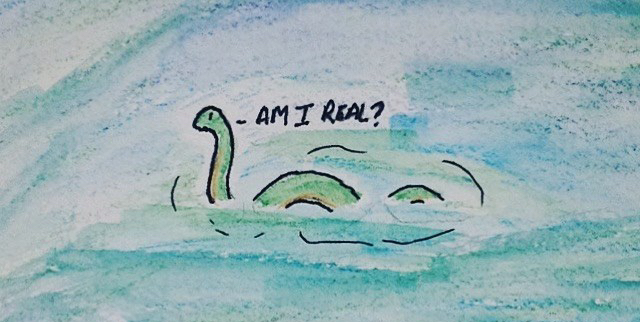
SCOTLAND’S famous Loch Ness has a mystic aura. The waters are surprisingly rapid, the winds heavy, and its sheer expanse contrasts dramatically with the jagged cliffs and mountains which frame it.
If a sea monster was ever to emerge from the depths and expose itself to humanity it wouldn’t look out of place here.
This is a circumstantial observation of course, heavily influenced by the legendary monster sightings which have made Loch Ness a household name. If not for the loch’s elusive cryptid, its claim to fame would be its status as the second deepest water body of its kind in Scotland. That’s not boring, but it pales in comparison to the legend of a living aquatic fossil.
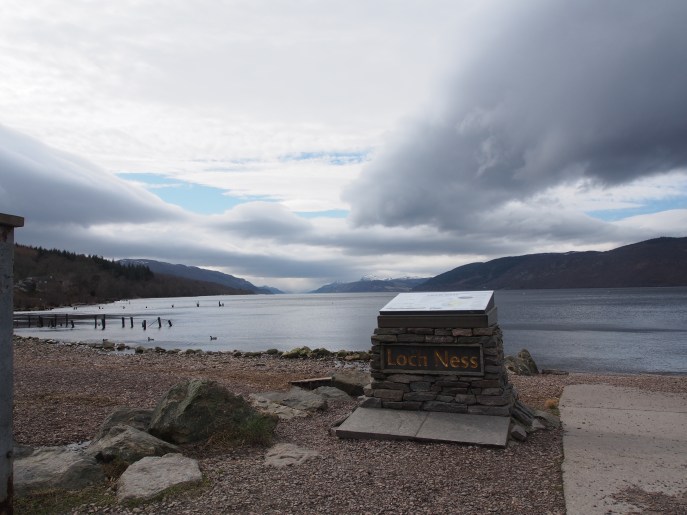
I visited the loch on a blustery March morning not in pursuit a beast, but for insight into what might have been had I followed a dream floated a decade ago in a conversation about career and life.
It was then I decided I wanted to be a cryptozoologist – one who hunts and studies the mythical beasts which capture imaginations across the globe.
The career was a hard sell and I ended up a journalist. However, the interest persisted, and having come into enough cash for flights through sheer luck (a scratchie card) I booked a trip in the hope of meeting someone who’d done what I’d dreamed of doing years before.
That’s how I came to meet a monster hunter.
Origins
Twenty-seven years ago, Steve Feltham decided he’d had enough.
Tired of installing burglar alarms in partnership with his father – a career he openly hated – Steve sold his south England home with a view to chasing his dream.
Without further context the scenario is not all that unfamiliar. Stories abound of successful people who left career jobs to chase passions. The psychology of sea change is interesting, but the act is not particularly uncommon.
For Steve, though, things were a little more complicated. Instead of a record store or a restaurant or a career in freelance journalism, Steve gave his career away in a bid to solve the mystery of the Loch Ness Monster.
Every morning since 1991, when the then 28-year-old upped and relocated to an initially mobile and now very stationary converted library van on Dores Beach, Steve has woken up to the lapping of the famed loch with an open schedule and mind.
His dedication to finding the Loch Ness Monster has become something of legend in its own right, garnering a BBC documentary, Guinness Book of Records recognition and a number of alarmist Daily Mail headlines over the years.
Despite the attention, and a full-time search which started as the Cold War ended, he’s yet to conclusively find the beast.
A day in the life
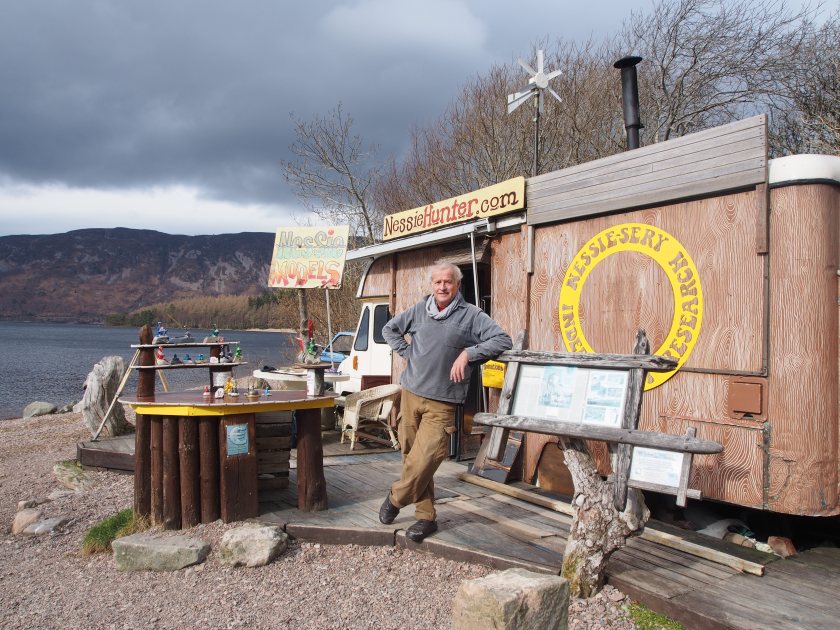
Steve spends his days making models of the monster to sell to tourists and sustain his lifelong adventure.
When it’s calm he’s behind a set of binoculars looking for any hint of activity on the loch. On this particular day he put them to one side to tell me a bit about the mystery which has gripped him since first visit in 1970, and the life he’s built since.
“I came here on a family holiday when I was seven, and that’s what got me hooked on the subject,” Steve said, pausing briefly to stare out across the water.
“We went to see the green field over there. In that field was the Loch Ness Phenomena Investigation Bureau, with all their cameras and caravans – they’d built a platform with a camera on a tripod and a lens about a metre long.”
The late 1960s and early 1970s were an interesting time in the history of the Loch Ness Monster narrative. The Loch Ness Phenomena Investigation Bureau Steve spoke of was a volunteer body which believed a plesiosaur lived in the depths of the loch, and spent every summer for around a decade trying to find it.
The group comprised some esteemed names, including conservative politician and founder David James, author of More Than a Legend: The Story of the Loch Ness Monster Constance Whyte, and Tim Dinsdale, himself an authority on the topic whose books detail his efforts to uncover the beast throughout his lifetime.
For an inquisitive child, this work proved a spark which ultimately took hold.

“I was a seven-year-old boy watching grown men and women look for plesiosaurs,” Steve said.
“It just caught my imagination that that would be possible in this country – my interest grew from there.”
Books were read and theories developed. Several more family holidays to the loch served to keep the flame burning through the years and into adulthood, when every spare moment of Steve’s was spent by the waters of Loch Ness.
“I was a seven-year-old boy watching grown men and women look for plesiosaurs”
“It was then I realised coming up here and doing this, even just for a week or two on holiday, filled me with so much joy and contentment,” he said.
At 28, he packed up and made it his life.
Career
The continued elusiveness of the monster may paint Steve as a failure to some – he claims to have seen something just once in almost three decades full-time on the loch. But it was clear almost immediately that his pursuit is as much a lifestyle as it is a life’s work.
The clues lie in his surrounds. Dores is an ATM-less Scottish throwback town of around 100 which is known for its inn, beach and Steve. The three share a car park. The young staff at the inn openly call their town ‘backward’. Quaint may be the better turn of phrase, at least as an outsider.
Beyond Nessie, Dores has allowed Steve to create a life he could only dream of on cold winter mornings working in Dorset and the cash-driven mentality of his past life.
“I think initially I had the work-life balance right,” he said, looking back on years gone by.
“I think initially I had the work-life balance right”
“I spent 10 years working in various creative pursuits. I was a graphic artist and a potter and a book binder – in those years I was coming up here in my spare time.
“But the mid-80s in this country was Thatcher’s era and all about money, so when my dad retired from the police to set up a one-man operation installing burglar alarms, I quit the creative work and went into partnership with him.

“I instantly hated it.”
One of the few benefits Steve saw in his work was the opportunity to talk to older people – those outside his sphere who offered insight by virtue of their life experiences.
He heard story after story of adventure and regret. In the long run, Steve said these conversations served as a trigger.
“They’d make you a cup of tea and tell you all the things they wished they’d done, or the things they had done in their lives,” he said.
“I realised at my rate I was going to get to my deathbed and look back wishing I’d tried to find an adventure full-time at Loch Ness.
“The fear of the unknown was less than the fear of the regret at the end of my life, so I decided to do it.”
Drawing from his own experience, Steve said he believed there was merit in working a job you hated.
“There’s nothing that focuses the mind more than getting up on a cold winter’s morning to go do something you don’t want to do. It helps you work out what you do want from life,” he said.
“The fear of the unknown was less than the fear of the regret at the end of my life, so I decided to do it”
“It doesn’t matter what anyone else thinks of what you want to do with your time, if you can lock onto it with the conviction that it will work, no matter how odd it may be, there’s a joyous time to be had out there following your heart rather than your wallet.”
Nessie
One sighting in 27 years seems a worryingly low strike-rate for a full-time monster hunter.
On what he’s seen, Steve’s opinion has changed. He no longer believes there is a plesiosaur in Loch Ness as he did in the beginning. However, he holds firm that the 54 square kilometre loch holds secrets undiscovered.
“There’s a whole range of different things people believe could be the explanation,” he said.
“It could be catfish, sturgeon, giant eels, there’s one guy who believes there’s a space ship at the bottom of the loch – whatever pops up to be the explanation is what I’ll photograph.”
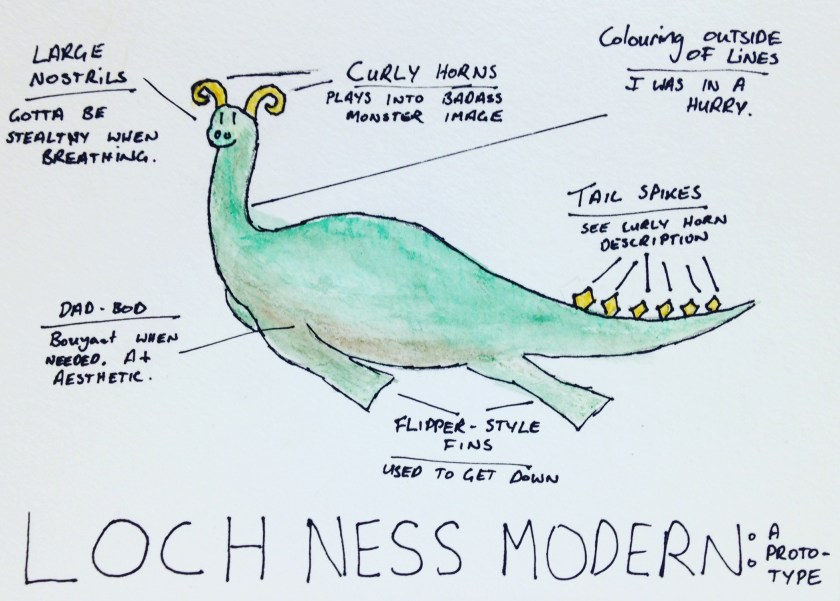
Steve’s continued conviction comes from his faith in the people he knows. Respected peers have confided in him time after time. His goal is simply to credibly catch the source of the mystery on still or moving film.
“I’m convinced mostly, not because of the photographic evidence which is all pretty sketchy, but the reliable, local eyewitnesses,” he said.
“These are people who have lived on the side of this body of water all their lives and know all the false alarms, and then one day they say ‘I’ve seen the back of a big animal with water spraying off the sides as it courses through the bay.
“Hearing that from somebody who would never tell the outside world what they’ve seen but knows I’m not here to take the mick – that’s what keeps me convinced.”
And if he one day solves the mystery?
“That would be fantastic for me, because presuming it’s me who gets the final piece of information, the adventures to follow would be so unpredictable,” he said.
“I’d love to know what invitations would come of that. Once you’ve solved this mystery, any other seems like a walk in the park, really.”
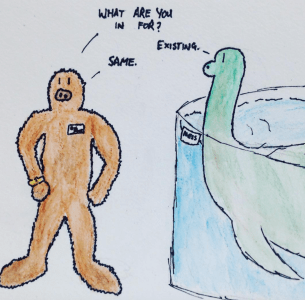 But for now, as it has been for more than a quarter of a century, Steve’s full-time focus is firmly on the Loch Ness Monster. No other mystery has captured him in quite the same way as the one he first learned of as a seven-year-old.
“I have been invited to look for Selma in Lake Seljord in Norway, and there were a few other exhibitions I’ve spoken to people about that never came off, but I’m happy with this one,” he said.
“People assume I have a biding passion for yetis and everything else, but this is the one thing I’m fixated on – it’s here in this loch.
“The beauty of living here is knowing the answer is in this stretch of water in front of us, it’s not like being a yeti hunter and wandering off into the Himalayas.
“That and the view. I’m as content now as I was on my first day at Loch Ness.”

Text, photographs and illustrations by Jack McGinn, 2018.

 Diplodopest.
Really good piece of writing Jack, really got a feel for Steve’s journey. Hopefully he finds Nessy one day!
Definitely jealous of your adventure. You’ve got a knack for storytelling, keep it up!
LikeLike
Thanks heaps Akash! Appreciate the feedback :).
LikeLike
Fantastic story! Your writing kept me riveted. I might join in the Nessie hunt now 😉
LikeLike
Thanks Pey-Sue!
LikeLike