Finding Franklin II

Not even the chill of an overcast winter morning by the docks of the Tasmanian coastal town of Kettering could cool the enthusiasm of Matthew Garth in June 2022, as he chased answers to a mystery more than four decades in the making. 

The 65-year-old Sydneysider, once a Navy man turned helicopter pilot, wound up at the town’s ferry terminal having spent the month prior scouring the bays of Tasmania – starting north, working south – seeking a lost love on which he last laid eyes in 1977, aged just 20. 

It had been 45 years since Matthew last saw Franklin II – a grand, 43ft wooden yacht once an icon for those, like him, who attended the Royal Australian Navy College at HMAS Creswell in Jervis Bay, New South Wales, in the halcyon days of the 1970s.
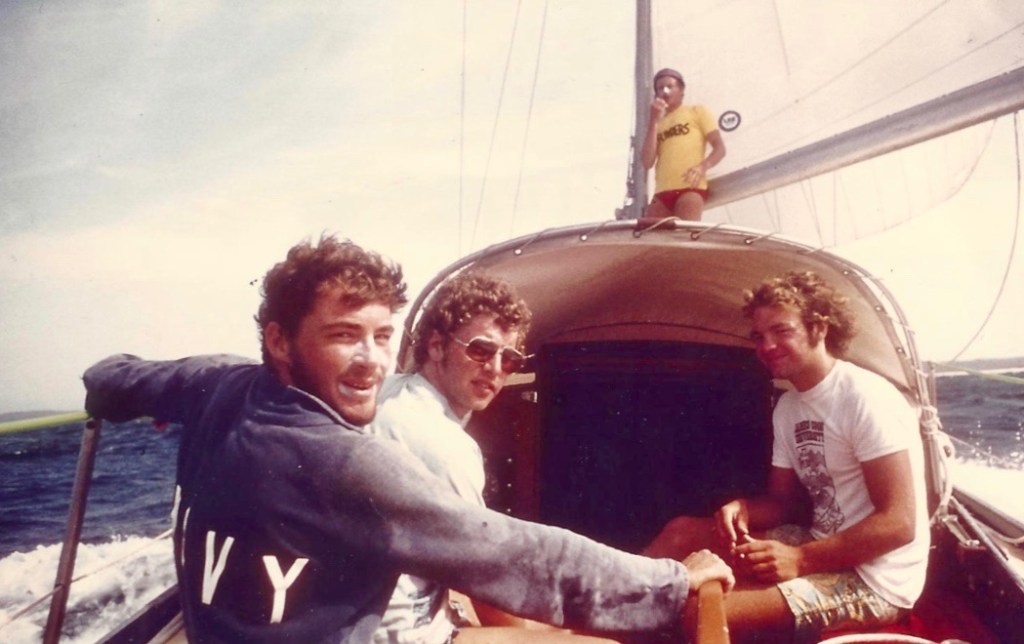
Students of the Royal Australian Navy College aboard Franklin II in 1976.
Pic: Supplied by Matthew Garth

A veteran of an incredible 12 Sydney to Hobart yacht races between 1962 and 88, Franklin II was once a Aussie Naval stalwart – a staple for those who cut their teeth at the college. But she had inexplicably faded into obscurity after leaving military hands in the mid-1990s.

To Matthew’s knowledge there was not a photo or a sighting in almost 30 years. Forty-three feet into thin air. How does a yacht with such presence and history just disappear?

He had spent many years physically and digitally searching for an answer to that question, and on this wintery day believed he may well be a short ferry ride from an answer.

Australian stories like that which drove Matthew to Kettering are usually played out over a few beers at the local pub. They’re thought bubbles that are touched on and dreamed about. The sort of thing Paul Kelly or Jimmy Barnes might write a song about. 

It’s rare to see a story like this followed to conclusion. But Matthew believed he was close to becoming an exception.
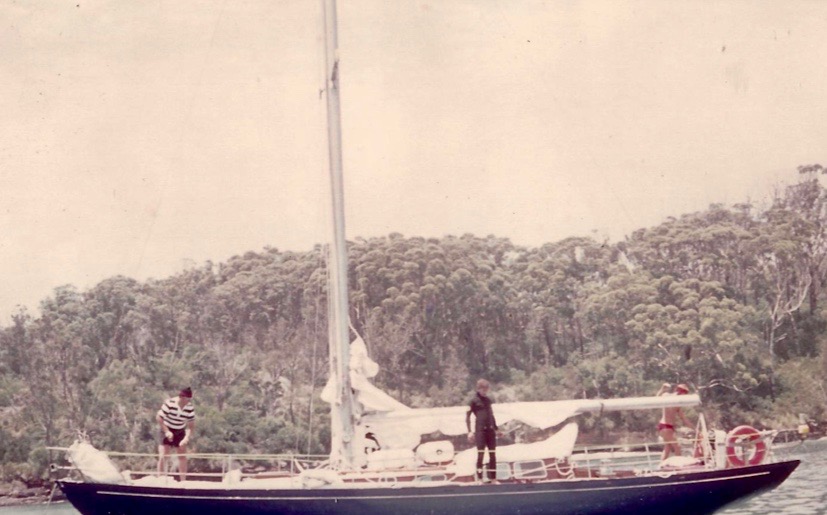
Franklin II in 1976. Pic: Supplied by Matthew Garth

Franklin’s first impressions, Matthew’s stoic search

Franklin II, Matthew explained with coffee in hand ahead of the 9.50am ferry to Bruny Island, was the vessel which most captured his 16-year-old imagination when he began a four-year Navy training stint in 1973. 

Built on Garden Island in 1962 and named for the Tasmanian Governor Sir John Franklin, the yacht was unlike any other Navy boat of its era. It was a fixture of the fleet, on which thousands learned their trade over the decades on the waters around Jervis Bay.

Franklin II was once known for its prominent shape and distinctive paint job – a deep blue with a gold trim designed to replicate the former royal yacht Britannia – which after an esteemed career at sea is now retired and stationed at Edinburgh in Scotland.

Franklin II in the 1968 Sydney to Hobart.
Pic: Sydney to Hobart

While the Queen’s former ship became an international tourist attraction, Franklin II would vanish. After a brief stint with the Army in the early 1990s, the ship was sold into civilian hands in 1995 and disappeared from public awareness shortly after – an Australian sailing mystery worthy of Bermuda Triangle mythos. 

She became the fodder of conversation over drinks, emails and text messages between Navy veterans. Those conversations were fruitless, and the questions around what came of Franklin II endured with no leads throughout the 2000s. 

It was a disappearance that toyed with Matthew’s mind.

After years flying choppers in the North West, his pursuit of an answer escalated on his family’s return to Sydney from WA in 2013, when he started kayaking around the marinas and harbours of New South Wales in search of the yacht. 

“For some reason I had in my mind that she would be in the main harbour at Sydney – the sort of place you expect to find such a grand yacht like Franklin,” Matthew said. 

The expeditions would come up blank, and for many years the pursuit looked dead in the water. However, an unexpected lead would soon emerge and set Matthew on a path for the Apple Isle.

In 2021, the recently retired Matthew spotted a feature story published on Defence News – a government website maintained by Navy staff – which offered his first concrete lead on Franklin since 1977. He learned the yacht had been restored in private hands and was headed to its new home, somewhere in Tasmania.

He did the only logical thing.

“I went to the north of Tassie in May to continue my search, stopping at marinas and calling yacht clubs trying to track her down,” Matthew said. 

As he was about to call off his search, Matthew received a tip from the Wooden Boat Guild of Tasmania. On June 23, it put him on a path for the ferry from Kettering to Bruny Island.

The Neck at Bruny Island, taken from Truganini Lookout.

Brothers in arms

Peter Schwartz stood casually at the Bruny Island Ferry Terminal, waiting for a visitor he’d never previously met. 

A retired builder with an accent which pays ever so slight homage to his American heritage, Peter couldn’t have found a better place to embrace his long-held passion for the sea. 

He and partner Karen recently relocated to the island from New South Wales. The couple live at Sykes Cove – a secluded spot where they purchased neighbourless waterfront acreage many years earlier, before the market took off. 

Peter’s current project is a self-sustaining forever home, built to look out over the water and take in the sort of vista you could spend a lifetime searching for.

In some ways, Matthew had.

Peter and Matthew had previously spoken only by phone, but they greeted one another warmly, quickly piling into a car and taking off into the island.  
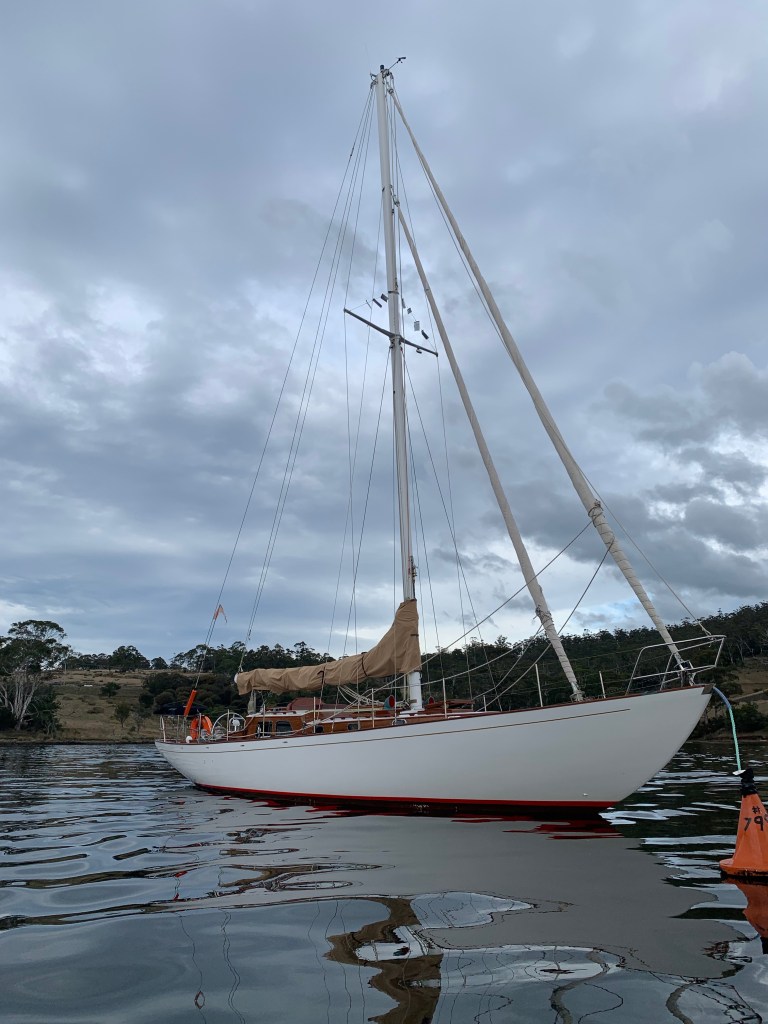
Franklin II in 2022, off Sykes Cove at Bruny Island.

After about 10 minutes, the vehicle strained past a tree clearing on a cliff overlooking the cove Peter calls home. 

It was here, from the passenger side of a beat-up sedan on a small Tasmanian island, that Matthew laid eyes on Franklin II for the first time in 45 years.

In the cove waters below she rocked gently and alone – no boat in sight save for a small metal dinghy tied to a post near the shore. 

No longer the royal blue of her youth, in 2022 she’s finished in off-white, with golden stripe remaining and a near-immaculate wooden finish to the deck. 

“I never would have found her here,” Matthew muttered under his breath. 

“You would have had a hard time finding her anywhere,” Peter replied. 

“We had her off the water for the best part of 20 years.”

How did Franklin get here?

In the most ridiculous way imaginable, of course. While some of us were trading Pokemon, Peter was swapping boats. And in 1996, he traded a 33ft fiberglass boat to a corporate high-flyer from New Zealand for Franklin II, which after a brief sailing stint was put into a NSW store yard for 22 years. 

Here Peter worked off and on in his spare time over the decades, before the pandemic refreshed his enthusiasm for the project and proved the ultimate catalyst which put her back on the water. That’s a feat in itself – it’s estimated just 50 per cent of the projects in the Taren Point store yard make it back out.
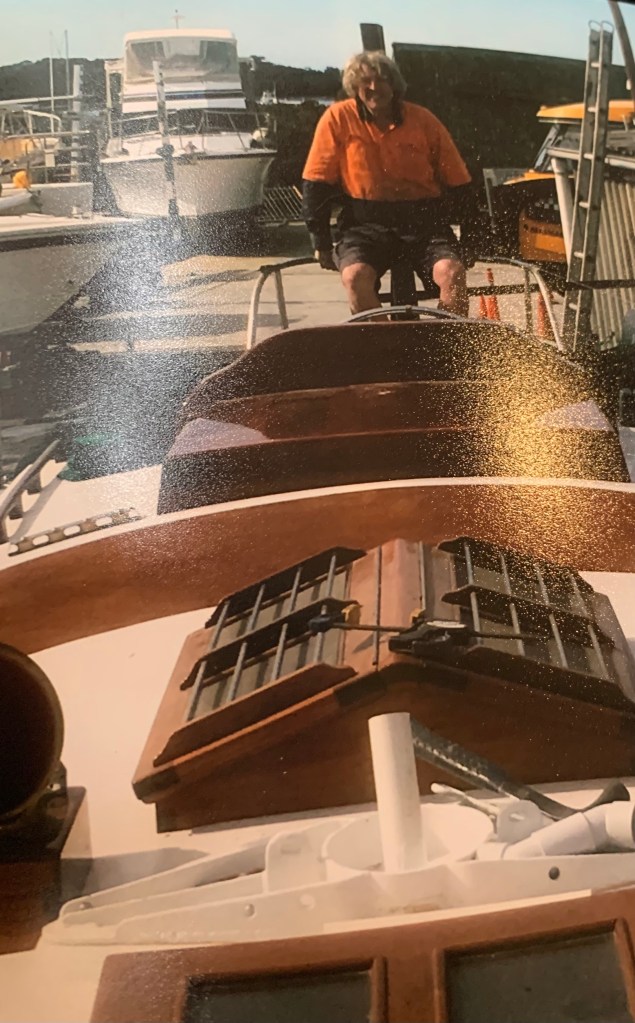
Peter at work on Franklin II – a photo of a photo.
Pics: P. Schwartz

Had Franklin II been in less caring hands, and with less support from knowledgeable shipwrights who helped advise the process, there’s a fair chance her story, and Matthew’s search, could have ended at a New South Wales tip.

Instead, the yacht was rebuilt and refurbished with utmost respect for its past, and a view to a future on the Tasman Sea.

Franklin II finally made it back to water in December 2020. In April, Peter and Karen were invited by the Navy to sail back to Jervis Bay, and presented with the boat’s original nameplate and plaques recording her adventures in the Sydney to Hobart races. 

The account of this event penned for Defence News mentioned Peter and Karen’s intention to take the boat to its new home in Tasmania – and became Matthew’s Tasmanian lead, though a misspelling of their surname set him back to some extent. 

But finally, after about a month on the road, Matthew would soon have his moment at one of the southernmost points in the nation.

He was about to sail on Franklin II once more. 

One man’s life work, another’s life mission

Peter reels in a dinghy, with Franklin II in the distance.

Peter was soon trudging his boots through the shallows of Sykes Cove, reeling in the dinghy beneath ominous skies.  

Before long, with Matthew at the wheel and Peter pulling ropes, the 60-year-old Franklin II was gracefully sailing across the Tasman, hitting a speed of seven knots as it carved its way through the grey waters surrounding the island. 

Matthew takes the wheel, 45 years since he last set eyes on Franklin II.

Matthew asked question after question, and told of the yacht’s significance to those who trained at HMAS Creswell during his era. 

Peter shared his experience with the yacht – filling puzzle pieces which had eluded the knowledge of even the most diligent of Naval historians for decades.

For Matthew, it was a real-life dream moment – one which took him back to the age of 16, and the resolution to a search which most would have abandoned long ago. 

“Sometimes you’re asleep and you’re dreaming, and occasionally you’re awake but it feels like you’re dreaming,” he said at one point, with eyes glued to the ocean ahead.

The yacht sailed for around two hours – perhaps a touch longer – with the overcast conditions doing little to dull the duo’s enthusiasm. 

With the dark beginning to set in, the pair eventually decided it was time to call it a day.

Matthew got one last glimpse of Franklin II on the drive back to the ferry terminal. At least for now. There’s talk of an overnighter on the yacht at some point soon.

A life’s work (left), a life’s search (right).

Despite that, a significant chapter was now closed. As he rode the ferry back to Kettering ahead of a drive into Hobart and a flight home to Sydney the following day, Matthew was introspective.

“At 60 she’s a little younger than me, but I’m sure she will long outlive me and bring joy to many more sailors for at least another 60 years,” he said. 

There’s probably a Paul Kelly song in that, too.

In pursuit of a monster: lessons from Loch Ness

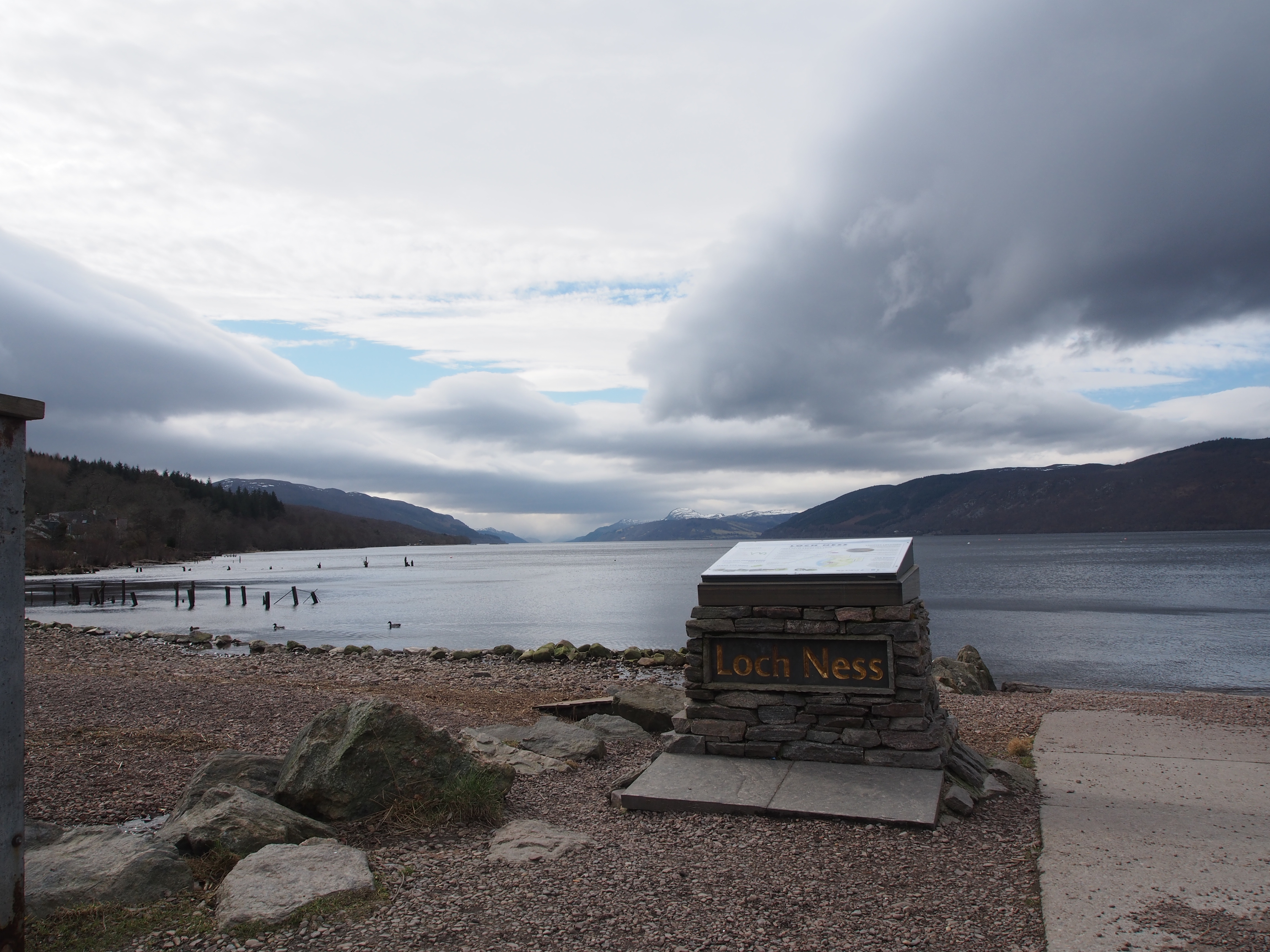
SCOTLAND’S famous Loch Ness has a mystic aura. The waters are surprisingly rapid, the winds heavy, and its sheer expanse contrasts dramatically with the jagged cliffs and mountains which frame it.

If a sea monster was ever to emerge from the depths and expose itself to humanity it wouldn’t look out of place here.

This is a circumstantial observation of course, heavily influenced by the legendary monster sightings which have made Loch Ness a household name. If not for the loch’s elusive cryptid, its claim to fame would be its status as the second deepest water body of its kind in Scotland. That’s not boring, but it pales in comparison to the legend of a living aquatic fossil.

OLYMPUS DIGITAL CAMERA

I visited the loch on a blustery March morning not in pursuit a beast, but for insight into what might have been had I followed a dream floated a decade ago in a conversation about career and life.

It was then I decided I wanted to be a cryptozoologist – one who hunts and studies the mythical beasts which capture imaginations across the globe.

The career was a hard sell and I ended up a journalist. However, the interest persisted, and having come into enough cash for flights through sheer luck (a scratchie card) I booked a trip in the hope of meeting someone who’d done what I’d dreamed of doing years before.

That’s how I came to meet a monster hunter.

Origins

Twenty-seven years ago, Steve Feltham decided he’d had enough.

Tired of installing burglar alarms in partnership with his father – a career he openly hated – Steve sold his south England home with a view to chasing his dream.

Without further context the scenario is not all that unfamiliar. Stories abound of successful people who left career jobs to chase passions. The psychology of sea change is interesting, but the act is not particularly uncommon.

image2
Are you?

For Steve, though, things were a little more complicated. Instead of a record store or a restaurant or a career in freelance journalism, Steve gave his career away in a bid to solve the mystery of the Loch Ness Monster.

Every morning since 1991, when the then 28-year-old upped and relocated to an initially mobile and now very stationary converted library van on Dores Beach, Steve has woken up to the lapping of the famed loch with an open schedule and mind.

His dedication to finding the Loch Ness Monster has become something of legend in its own right, garnering a BBC documentary, Guinness Book of Records recognition and a number of alarmist Daily Mail headlines over the years.

Despite the attention, and a full-time search which started as the Cold War ended, he’s yet to conclusively find the beast.

A day in the life

OLYMPUS DIGITAL CAMERA
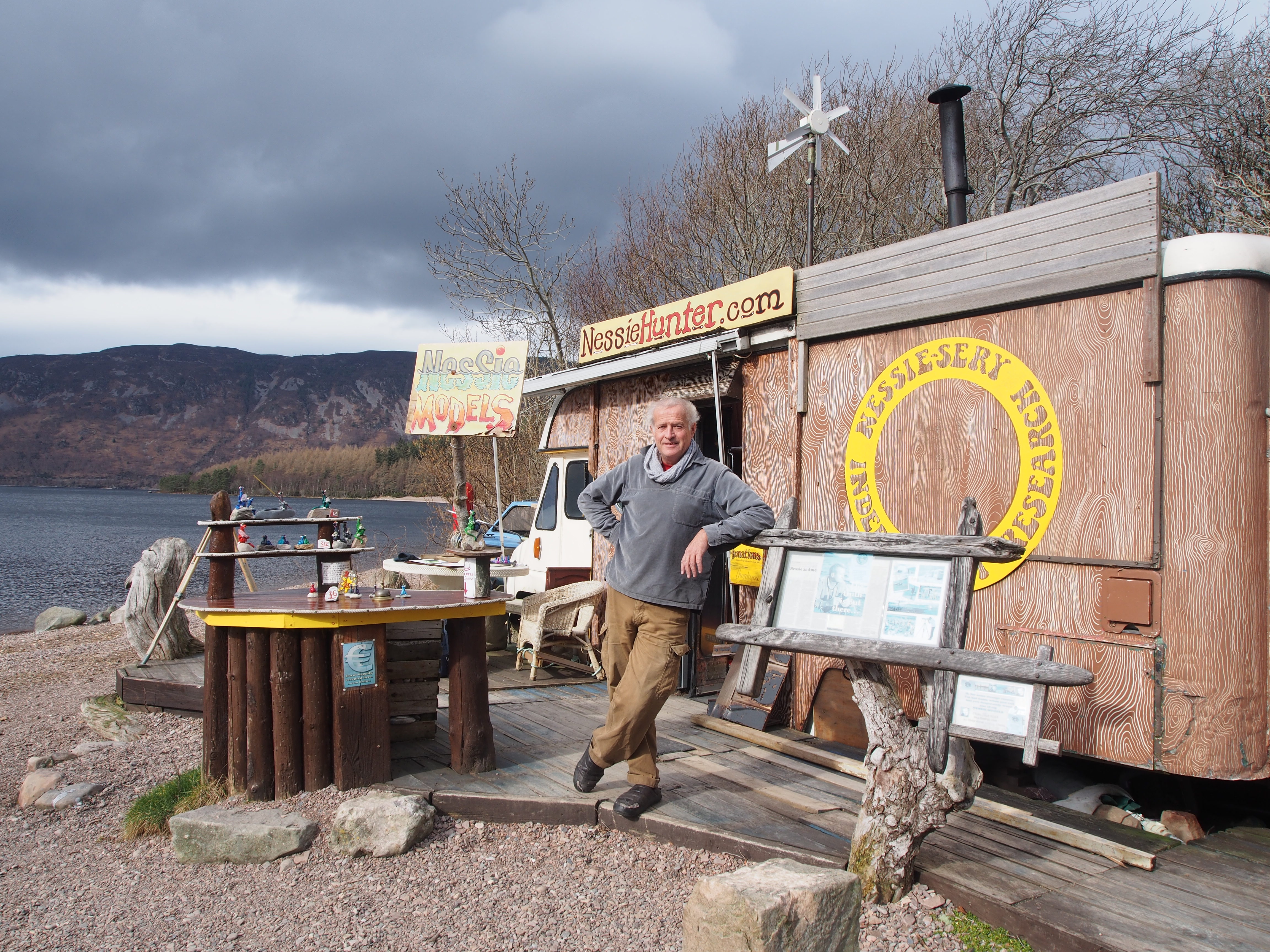
Steve outside his converted library van home. 

Steve spends his days making models of the monster to sell to tourists and sustain his lifelong adventure.

When it’s calm he’s behind a set of binoculars looking for any hint of activity on the loch. On this particular day he put them to one side to tell me a bit about the mystery which has gripped him since first visit in 1970, and the life he’s built since.

“I came here on a family holiday when I was seven, and that’s what got me hooked on the subject,” Steve said, pausing briefly to stare out across the water.

“We went to see the green field over there. In that field was the Loch Ness Phenomena Investigation Bureau, with all their cameras and caravans – they’d built a platform with a camera on a tripod and a lens about a metre long.”

The late 1960s and early 1970s were an interesting time in the history of the Loch Ness Monster narrative. The Loch Ness Phenomena Investigation Bureau Steve spoke of was a volunteer body which believed a plesiosaur lived in the depths of the loch, and spent every summer for around a decade trying to find it.

The group comprised some esteemed names, including conservative politician and founder David James, author of More Than a Legend: The Story of the Loch Ness Monster Constance Whyte, and Tim Dinsdale, himself an authority on the topic whose books detail his efforts to uncover the beast throughout his lifetime.

For an inquisitive child, this work proved a spark which ultimately took hold.

image1
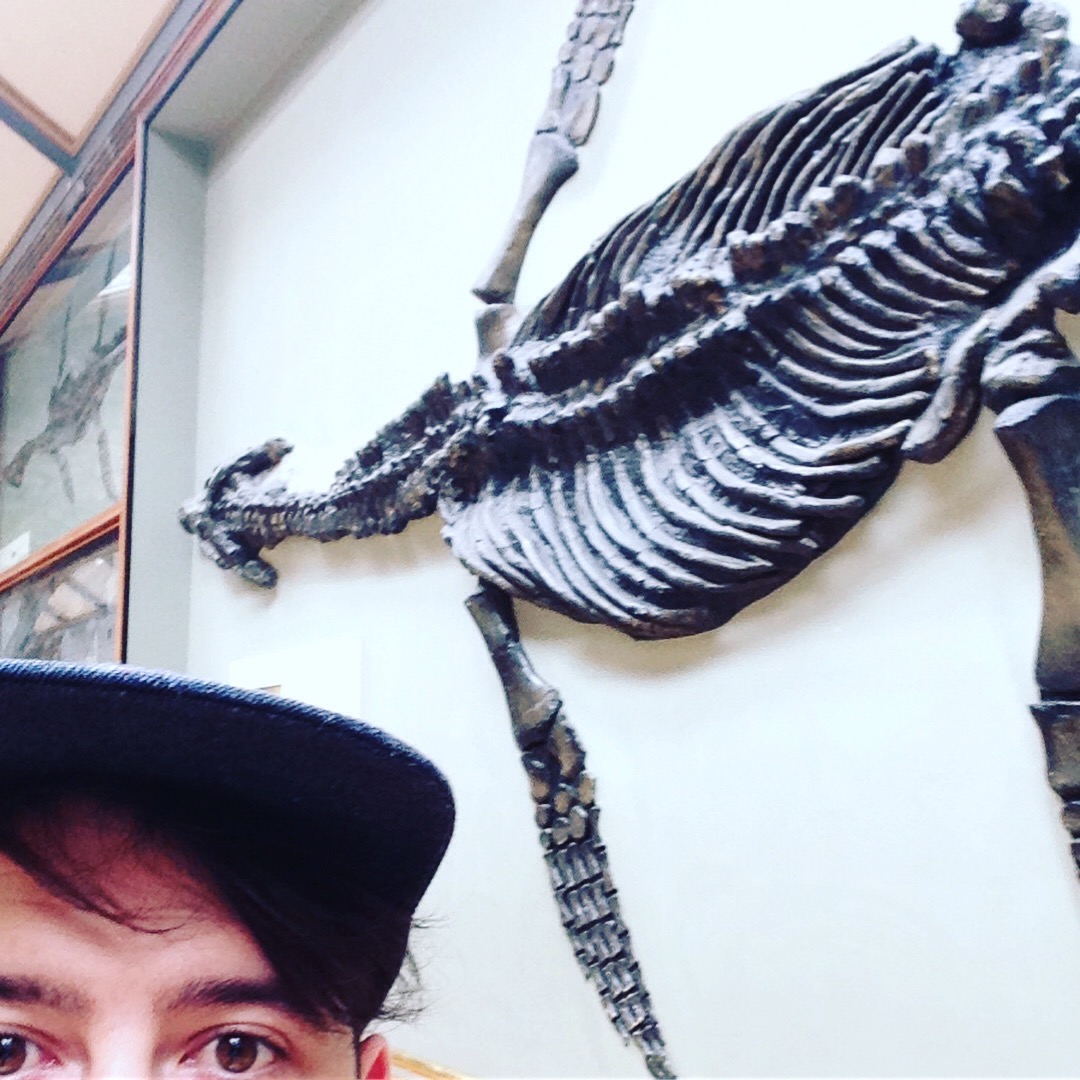
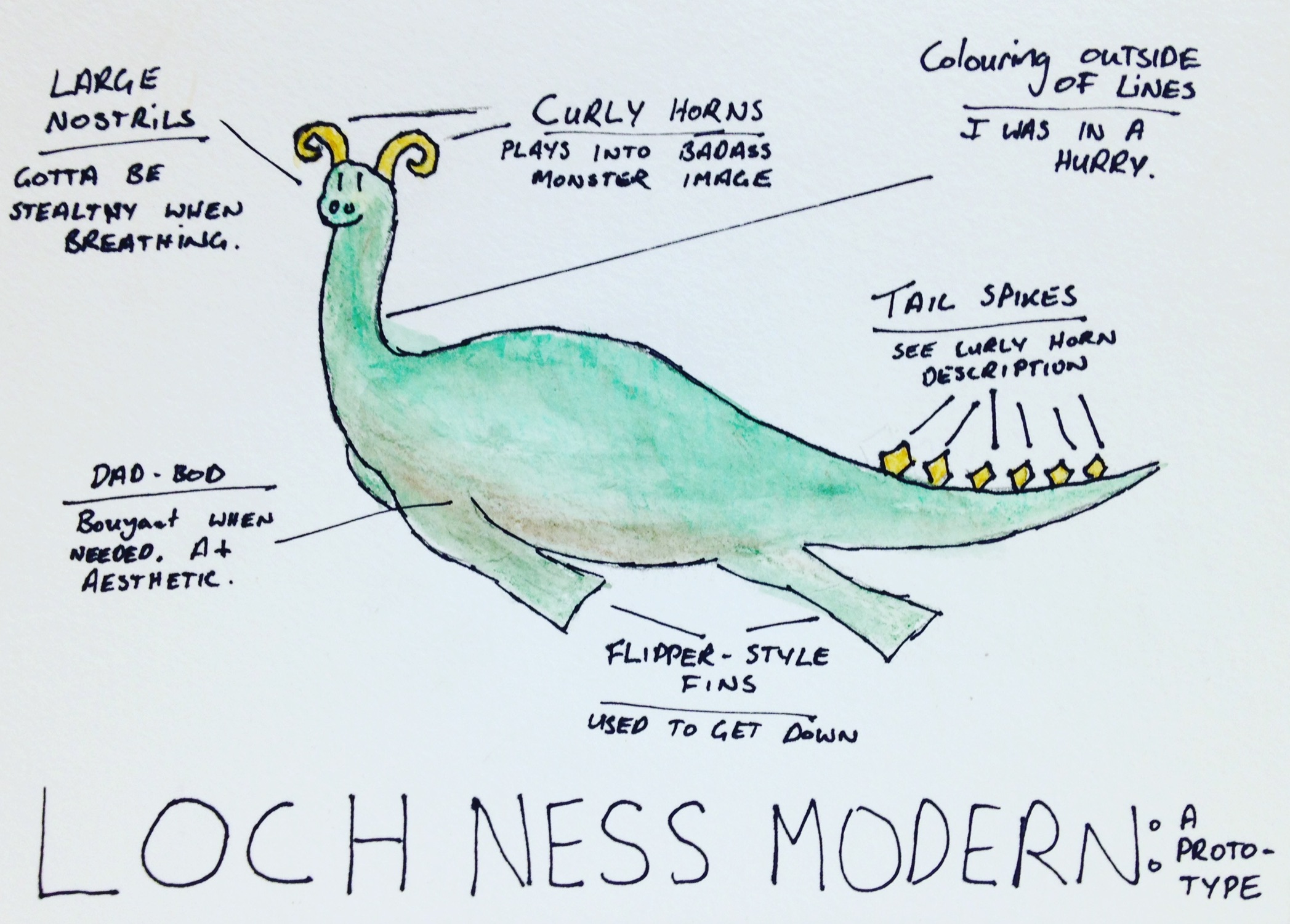
I found a plesiosaur, albeit at London’s Natural History Museum.

“I was a seven-year-old boy watching grown men and women look for plesiosaurs,” Steve said.

“It just caught my imagination that that would be possible in this country – my interest grew from there.”

Books were read and theories developed. Several more family holidays to the loch served to keep the flame burning through the years and into adulthood, when every spare moment of Steve’s was spent by the waters of Loch Ness.

“I was a seven-year-old boy watching grown men and women look for plesiosaurs”

“It was then I realised coming up here and doing this, even just for a week or two on holiday, filled me with so much joy and contentment,” he said.

At 28, he packed up and made it his life.

Career

The continued elusiveness of the monster may paint Steve as a failure to some – he claims to have seen something just once in almost three decades full-time on the loch. But it was clear almost immediately that his pursuit is as much a lifestyle as it is a life’s work.

The clues lie in his surrounds. Dores is an ATM-less Scottish throwback town of around 100 which is known for its inn, beach and Steve. The three share a car park. The young staff at the inn openly call their town ‘backward’. Quaint may be the better turn of phrase, at least as an outsider.

Beyond Nessie, Dores has allowed Steve to create a life he could only dream of on cold winter mornings working in Dorset and the cash-driven mentality of his past life.

“I think initially I had the work-life balance right,” he said, looking back on years gone by.

“I think initially I had the work-life balance right”

“I spent 10 years working in various creative pursuits. I was a graphic artist and a potter and a book binder – in those years I was coming up here in my spare time.

“But the mid-80s in this country was Thatcher’s era and all about money, so when my dad retired from the police to set up a one-man operation installing burglar alarms, I quit the creative work and went into partnership with him.

image4
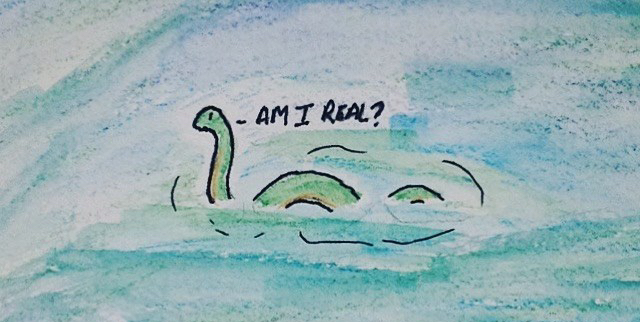
Is there an alien at the bottom of Loch Ness? One theory says so

“I instantly hated it.”

One of the few benefits Steve saw in his work was the opportunity to talk to older people – those outside his sphere who offered insight by virtue of their life experiences.

He heard story after story of adventure and regret. In the long run, Steve said these conversations served as a trigger.

“They’d make you a cup of tea and tell you all the things they wished they’d done, or the things they had done in their lives,” he said.

“I realised at my rate I was going to get to my deathbed and look back wishing I’d tried to find an adventure full-time at Loch Ness.

“The fear of the unknown was less than the fear of the regret at the end of my life, so I decided to do it.”

Drawing from his own experience, Steve said he believed there was merit in working a job you hated.

“There’s nothing that focuses the mind more than getting up on a cold winter’s morning to go do something you don’t want to do. It helps you work out what you do want from life,” he said.

“The fear of the unknown was less than the fear of the regret at the end of my life, so I decided to do it”

“It doesn’t matter what anyone else thinks of what you want to do with your time, if you can lock onto it with the conviction that it will work, no matter how odd it may be, there’s a joyous time to be had out there following your heart rather than your wallet.”

Nessie

One sighting in 27 years seems a worryingly low strike-rate for a full-time monster hunter.

On what he’s seen, Steve’s opinion has changed.  He no longer believes there is a plesiosaur in Loch Ness as he did in the beginning. However, he holds firm that the 54 square kilometre loch holds secrets undiscovered.

“There’s a whole range of different things people believe could be the explanation,” he said.

“It could be catfish, sturgeon, giant eels, there’s one guy who believes there’s a space ship at the bottom of the loch – whatever pops up to be the explanation is what I’ll photograph.”

image3

Steve’s continued conviction comes from his faith in the people he knows. Respected peers have confided in him time after time. His goal is simply to credibly catch the source of the mystery on still or moving film.

“I’m convinced mostly, not because of the photographic evidence which is all pretty sketchy, but the reliable, local eyewitnesses,” he said.

“These are people who have lived on the side of this body of water all their lives and know all the false alarms, and then one day they say ‘I’ve seen the back of a big animal with water spraying off the sides as it courses through the bay.

“Hearing that from somebody who would never tell the outside world what they’ve seen but knows I’m not here to take the mick – that’s what keeps me convinced.”

And if he one day solves the mystery?

“That would be fantastic for me, because presuming it’s me who gets the final piece of information, the adventures to follow would be so unpredictable,” he said.

“I’d love to know what invitations would come of that. Once you’ve solved this mystery, any other seems like a walk in the park, really.”

Screen Shot 2018-04-16 at 8.33.56 pmBut for now, as it has been for more than a quarter of a century, Steve’s full-time focus is firmly on the Loch Ness Monster. No other mystery has captured him in quite the same way as the one he first learned of as a seven-year-old.
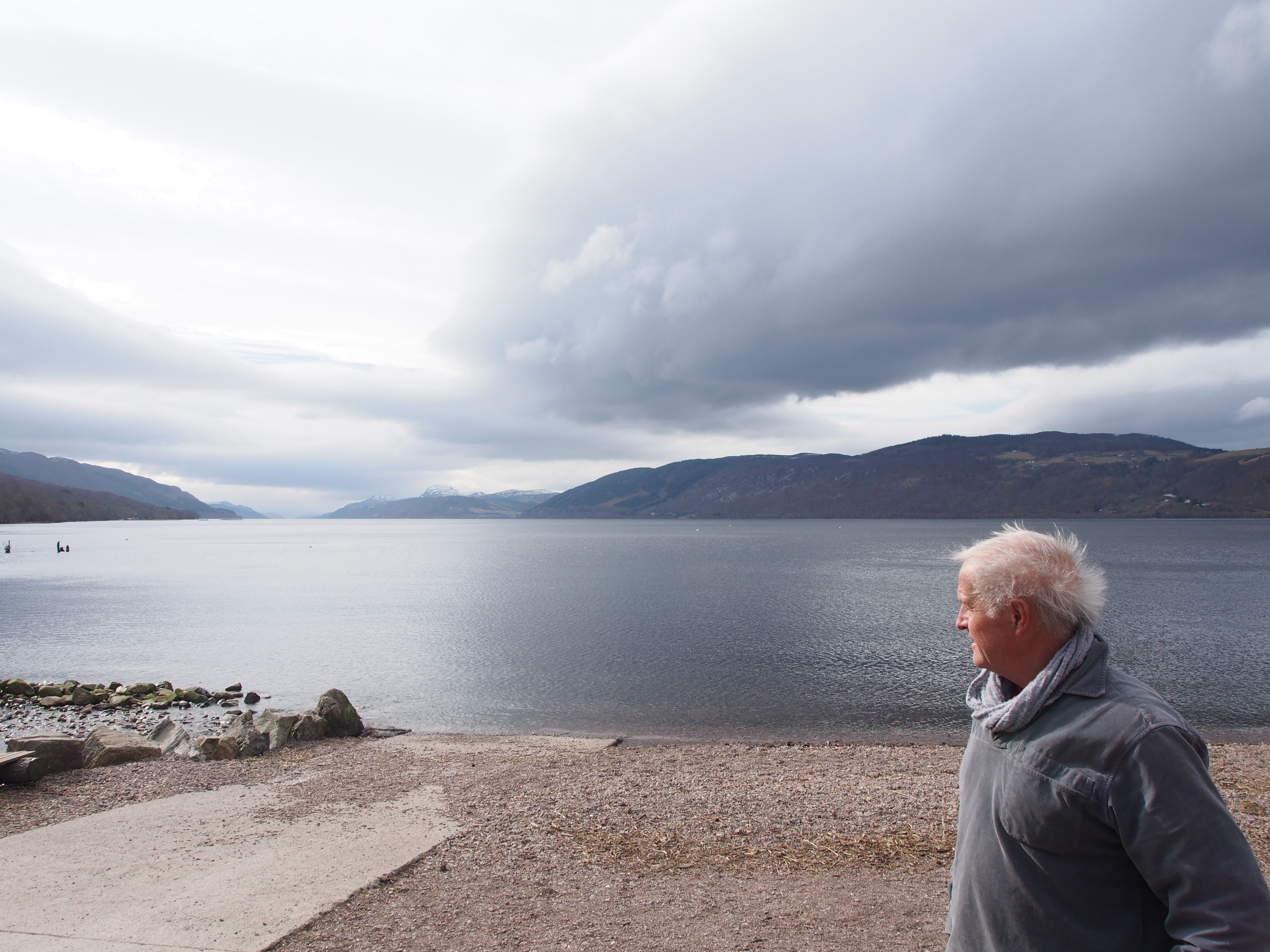
“I have been invited to look for Selma in Lake Seljord in Norway, and there were a few other exhibitions I’ve spoken to people about that never came off, but I’m happy with this one,” he said.

“People assume I have a biding passion for yetis and everything else, but this is the one thing I’m fixated on – it’s here in this loch.

“The beauty of living here is knowing the answer is in this stretch of water in front of us, it’s not like being a yeti hunter and wandering off into the Himalayas.

“That and the view. I’m as content now as I was on my first day at Loch Ness.”

OLYMPUS DIGITAL CAMERA
Steve’s search for the Loch Ness Monster is ongoing.

Text, photographs and illustrations by Jack McGinn, 2018.